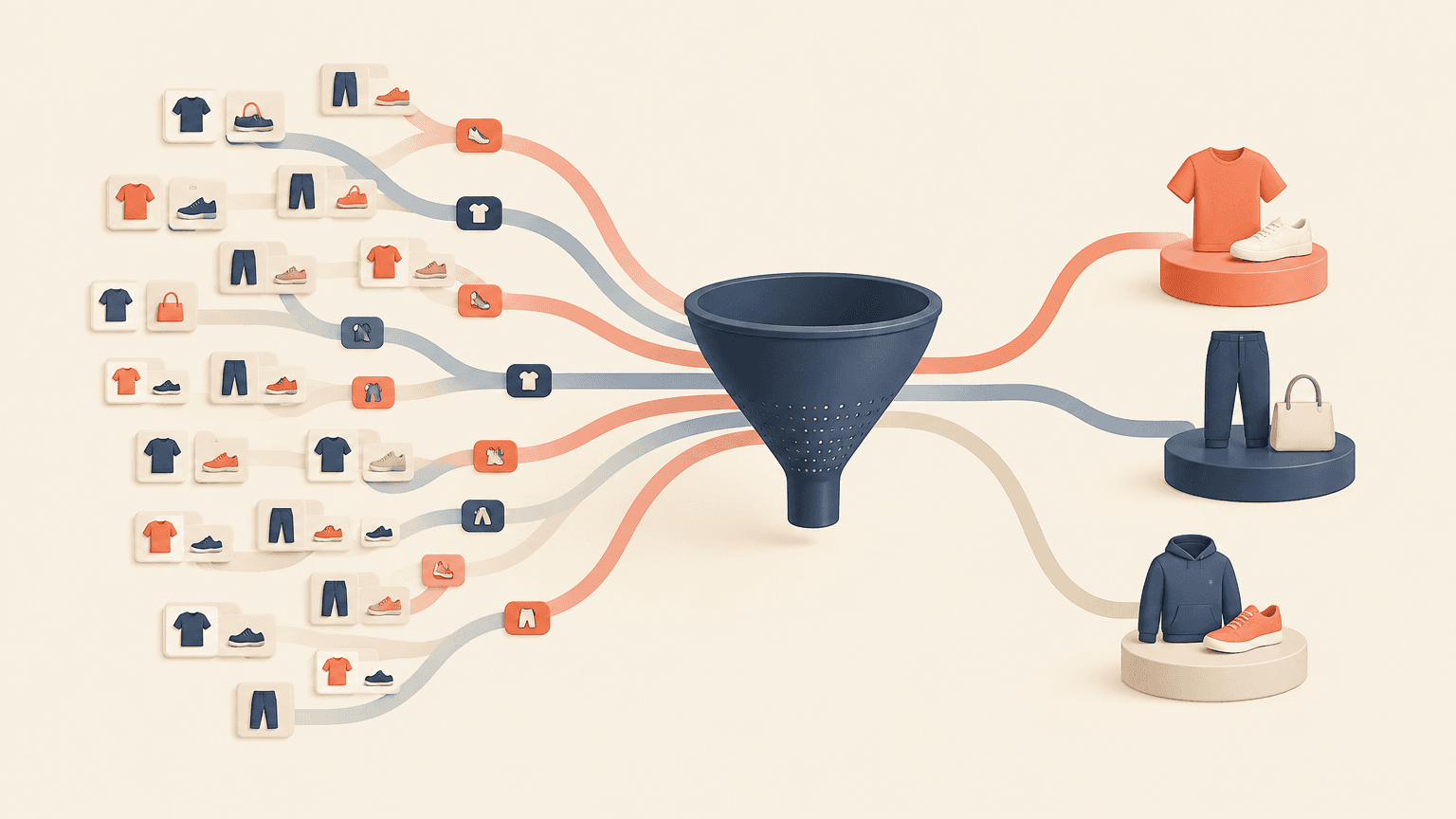
SEO for Faceted Navigation: Prevent Duplicate URLs Without Hiding Valuable Pages
Faceted filters can help shoppers find the right products—but unchecked URL variations can waste crawl attention and muddy indexing signals. Learn how to map filter combinations, choose crawl controls, and preserve pages with genuine search demand.
The safest way to reduce faceted-navigation crawl bloat is to separate filters that deserve search visibility from filters that only help shoppers refine a visit. Give valuable combinations stable, indexable landing pages. Consolidate genuinely duplicate URLs, keep low-value pages out of the index where appropriate, and limit the internal links that generate endless combinations. Do not start by blocking every parameter: that can prevent search engines from seeing canonical or noindex instructions and cut off useful product discovery.
This walkthrough is for ecommerce SEO teams working with developers and merchandising teams. The goal is a repeatable URL policy, not a collection of one-off fixes. Work through one representative category first, verify what crawlers actually encounter, and then extend the policy across the catalog.
How Faceted Navigation Creates URL and Indexing Problems
Faceted navigation lets shoppers narrow a category by attributes such as brand, size, color, material, availability, or price. The SEO problem begins when every selection produces another crawlable URL. A category with several independent filters can generate a large set of combinations, even though only a small subset represents useful search destinations.
In a hypothetical footwear store, /shoes/?color=black&size=8 and /shoes/?size=8&color=black might show exactly the same products. Add sorting, display mode, tracking parameters, repeated selections, and pagination, and the crawler can encounter multiple addresses for the same shopping state. Other combinations are not duplicates at all: they are narrow subsets with little independent search value. Those two problems require different treatments.
Duplicate addresses: parameter order, tracking values, or default selections create different URLs for equivalent content.
Low-value subsets: filters create distinct product lists that do not warrant separate search landing pages.
Crawl traps: open-ended values, repeated parameters, or unrestricted combinations keep producing new URLs.
Weak discovery paths: products appear only behind deeply filtered states or scripts that crawlers may not reliably follow.
Conflicting signals: internal links, sitemaps, redirects, and canonical tags point toward different preferred URLs.
Crawling and indexing are separate decisions. A search engine can repeatedly fetch URLs it never indexes, and an indexed URL does not necessarily receive search traffic. Diagnose all three layers: which URLs are discovered, which are fetched, and which become search landing pages. A high parameter-URL count alone does not prove that valuable pages are being neglected.
Inventory Filter Parameters and Their Crawl Impact
Build an inventory from the live interface, crawl exports, server logs, XML sitemaps, and Search Console. Each source answers a different question. The interface shows intended behavior; crawl exports expose discoverable paths; logs show actual requests; sitemaps reveal submitted preferences; and Search Console provides indexing and search-performance evidence. None is a complete inventory on its own.
Record each parameter or path segment, its purpose, allowed values, and whether multiple values can be selected.
Capture representative URLs, including parameter-order variants, default values, empty results, and invalid combinations.
Record HTTP status, canonical target, robots meta or X-Robots-Tag, robots.txt access, and sitemap inclusion.
Check whether the URL is linked through an HTML anchor, generated after interaction, or available only through JavaScript state.
Compare product sets and rendered content to identify equivalents, meaningful subsets, and pages that only change presentation.
Group log requests by URL family and inspect repeat fetching, response errors, and crawler access to categories and products.
Classify parameters by function rather than treating every question mark as a problem. Sorting and grid-view controls usually change presentation. Tracking values identify visits rather than content. Brand and material filters may define meaningful search intent. Size, price, and availability can be useful or low-value depending on the category, demand, and stability of the resulting inventory. Pagination needs its own review because it often exposes different products.
For log analysis, verify search-engine crawler identity rather than trusting the user-agent string alone. Compare request share and absolute request volume for each family over comparable periods. A rising percentage of filtered requests can reflect falling activity elsewhere, so do not rely on percentages without counts. Pay particular attention to URLs fetched repeatedly despite having no useful indexing role.
Inventory the rendered experience as well as the initial HTML. A filter URL that returns an empty shell until JavaScript runs may behave differently from what a basic crawler reports. Check representative pages with rendering enabled and inspect what search engines can access.
Decide Which Filter Combinations Deserve Search Landing Pages
Use an explicit allowlist for indexable filter destinations. It is easier to maintain a defined set of approved landing pages than to let every combination become indexable and remove weak pages later. Approval should reflect a distinct shopper need, an appropriate product assortment, and a page the business can maintain—not simply the fact that the platform can generate a URL.
Apply a landing-page qualification test
Distinct intent: does the combination answer a recognizable product-selection need rather than a temporary interface preference?
Demand evidence: do search queries, internal search behavior, existing landing-page performance, or keyword research support that need?
Assortment quality: are there enough relevant products to provide a useful choice, with availability that is not constantly collapsing?
Meaningful differentiation: is the page materially different from an existing category or approved facet page?
Maintainability: can the team keep the URL, title, heading, navigation links, and product-selection rules consistent?
Discovery value: can the page fit into a sensible category hierarchy instead of existing as an isolated SEO destination?
In a hypothetical kitchenware catalog, a stainless-steel cookware filter might qualify because it represents a durable product attribute and a distinct shopping need. Stainless-steel cookware sorted by price does not create a new intent. Adding an in-stock toggle and a narrow price interval may produce a useful shopping state without justifying another indexed landing page. The same logic should be evaluated against the store's actual demand and assortment.
An approved page should have a stable URL, a descriptive title and heading, an accurate product set, and relevant internal links. Add explanatory copy only when it helps shoppers understand the selection or make a choice. Changing a heading or adding boilerplate does not turn a near-duplicate page into a useful destination. Clean paths can make governance easier, but parameter URLs can also be valid landing pages when their signals are consistent.
Define how approved pages behave when stock changes. A temporarily depleted assortment may justify keeping a useful page live with accurate availability information and relevant alternatives. A permanently retired selection may warrant a redirect to a genuinely equivalent replacement, or a 404 or 410 response if none exists. Avoid automatically redirecting every discontinued facet to a broad category; that can mislead users and may be treated as a soft 404.
Choose Canonicals, Robots Directives, and Internal-Link Controls
Assign each URL family a primary treatment based on its purpose. Canonicals address preferred indexing among equivalent pages. Noindex addresses whether a crawlable page should appear in results. Robots.txt controls crawling. Internal-link design controls how much of the URL space the site exposes. These mechanisms are complementary, but they are not interchangeable.
Consolidate equivalent URLs with redirects or canonicals
Where the user experience permits, redirect redundant URL forms to a normalized version. Enforce consistent parameter ordering, remove unnecessary default values, and prevent repeated or invalid parameters from creating new states. Preserve campaign attribution where needed before stripping tracking values. When a presentation variant must remain accessible, a canonical to the equivalent preferred URL can be appropriate.
Canonical targets should be accessible, indexable, and genuinely equivalent to the source. Approved facet landing pages generally need self-referencing canonicals. A filtered subset is not automatically equivalent to its parent category, so a blanket category canonical may be ignored. Canonicals are signals, not guarantees, and crawlers still need to fetch source URLs to see them.
Keep useful shopping states out of search when necessary
For distinct filter states that shoppers need but that should not appear in search, use a crawl-accessible noindex directive in the robots meta tag or HTTP X-Robots-Tag. Remove those URLs from XML sitemaps and avoid promoting them as search landing pages. Do not expect noindex to prevent fetching: search engines must access the page to read the instruction.
Do not block a URL in robots.txt while expecting search engines to read its noindex or canonical. A blocked URL can still be known through links and may appear in results without its content being crawled. If an already indexed family needs removal, allow access to noindex first and verify the change before considering crawl restrictions.
Restrict wasteful discovery without cutting off products
Expose approved landing pages through normal crawlable anchors in category navigation and other relevant contexts. For combinations intended only as interface controls, consider buttons or forms rather than publishing an unrestricted mesh of crawlable links. Keep the controls accessible and test browser history, shareable states, and keyboard use. JavaScript alone is not a reliable crawl barrier, and rel=nofollow is not a dependable way to prevent crawling or indexing.
Robots.txt restrictions can help with clearly defined, low-value URL families that consume substantial crawling, but they require precise scope. Test patterns against approved facets and mixed-parameter URLs before deployment. A broad rule for all query strings can unintentionally block useful landing pages or pagination. Use crawl restrictions only after deciding whether existing indexed URLs need an accessible removal or consolidation instruction.
Preserve a dependable path to products outside excluded facets. Categories and crawlable pagination should expose the assortment, supported by accurate product sitemaps. Do not canonicalize every paginated page to page one merely because the template is similar: later pages contain different products. If infinite scroll is used, provide accessible paginated URLs rather than requiring scrolling as the only discovery mechanism. Links on long-term noindexed pages should not be the sole route to important products.
Approved search facet: indexable, self-canonical, internally linked, and eligible for sitemap inclusion.
Equivalent URL variant: redirect to the preferred URL where practical, or canonicalize while preserving necessary functionality.
Distinct low-value shopping state: crawl-accessible noindex, excluded from sitemaps, with restrained internal exposure.
Invalid combination: return an appropriate error or a legitimate normalization redirect rather than endless empty pages.
Validate Changes in Crawl Data and Search Performance
Record a baseline before changing templates. Save representative URLs from every policy class, current directives and canonicals, crawler request patterns, indexed-page observations, and search performance for approved facets, parent categories, and products. Annotate the deployment date and retain the rule configuration so unexpected effects can be traced or reversed.
Test implementation before interpreting SEO results
Crawl representative categories with and without rendering, and compare the facet links each approach discovers.
Confirm that approved pages return successful responses, remain crawlable, and use the intended self-canonical.
Inspect low-value pages for visible noindex directives and check that robots.txt does not prevent those directives from being read.
Test redirects for loops, chains, lost filter selections, and incorrect destinations.
Verify that XML sitemaps contain intended canonical, indexable URLs and that products remain reachable through ordinary links.
After deployment, inspect server logs for changes in requests to wasteful families and continued access to important pages. Search engines may revisit known variants even after internal links are removed, so an immediate disappearance is not a realistic requirement. Canonicalization and noindex processing also depend on recrawling; there is no universal timetable.
Use Search Console URL inspection on representative samples to compare declared and selected canonicals and investigate unexpected exclusions. Review page-indexing trends by URL family where possible rather than treating every excluded URL as an error. Duplicate or noindexed variants can be expected outcomes. An approved landing page being excluded, blocked, or canonicalized to an unrelated category deserves investigation.
Evaluate search performance separately from crawl efficiency. Track impressions, clicks, query relevance, and landing-page coverage for approved facets alongside their parent categories and products. Compare equivalent seasonal periods where available, and account for inventory changes, promotions, migrations, and broader search changes. Fewer crawler requests to filters do not, by themselves, prove a ranking or revenue improvement.
Investigate regressions by mechanism. If an approved facet loses visibility, check blocking rules, noindex inheritance, canonical selection, and internal links before rewriting content. If products lose discovery paths, restore category or pagination access. If crawl volume remains high, find the templates or external links still exposing unwanted variants instead of assuming canonical tags will stop requests.
Your next step is to choose one category and produce a URL-policy worksheet: parameter family, sample URL, landing-page decision, indexing treatment, link treatment, and validation check. Have SEO, engineering, and merchandising review it together. Deploy that small scope first, confirm that useful pages remain discoverable, and use the tested rules to expand across the catalog.